Nonograms are also called Griddlers, Hanjie, Paint by Numbers or Logimage. Many people know them as Picross, from Nintendo's games. The rules are the same under every name.
The rules
- The numbers beside each row and above each column tell how many boxes in a row to colour. The groups come in that order.
- Each number is one group of coloured boxes that sit next to each other.
- Row numbers go from left to right. Column numbers go from top to bottom.
- Leave at least 1 empty box between coloured groups.
- A 0 means the whole row or column stays empty.
- Boxes you do not colour count as empty.
- The puzzle is solved when every row and every column matches its numbers.
Quirk uses one colour. Some nonograms in books use several colours. There, two groups of different colours may touch without a gap.
A worked example
Here is a small board with 5 rows and 5 columns. Rows count from the top, and columns count from the left. These are its numbers.
| Line | Numbers |
|---|---|
| Row 1 | 3 |
| Row 2 | 2 2 |
| Row 3 | 5 |
| Row 4 | 1 1 |
| Row 5 | 2 2 |
| Column 1 | 4 |
| Column 2 | 3 1 |
| Column 3 | 1 1 |
| Column 4 | 3 1 |
| Column 5 | 4 |
- Row 3 has the number 5. The row has 5 boxes, so colour all of them.
- Columns 1 and 5 have the number 4. A group of 4 in 5 boxes always covers rows 2, 3 and 4. Colour those boxes in both columns.
- Row 2 has 2 2, and its first and last boxes are now coloured. The first group starts in column 1, so it covers columns 1 and 2.
- The second group in row 2 ends in column 5, so it covers columns 4 and 5. Column 3 of row 2 stays empty.
- Row 4 has 1 1, and its first and last boxes are coloured. Those are both groups, so columns 2, 3 and 4 of row 4 stay empty.
- Column 2 has 3 1. Rows 2 and 3 are coloured, and row 4 is empty. The group of 3 comes first and cannot cross row 4, so it fills rows 1, 2 and 3.
- The group of 1 in column 2 must come after the empty box in row 4. So it goes in row 5.
- Column 4 has the same numbers and the same marks as column 2. So colour rows 1, 2, 3 and 5 there too.
- Row 1 has 3, and columns 2 and 4 are coloured. One group of 3 must cover both, so it fills columns 2, 3 and 4.
- Column 3 has 1 1, and rows 1 and 3 are coloured. Both groups are there, so row 5 of column 3 stays empty.
- Row 5 has 2 2. Columns 2 and 4 are coloured, and column 3 is empty. So the groups fill columns 1 and 2, and columns 4 and 5.
- Check every line. Columns 1 and 5 now have rows 2 to 5 coloured, which is one group of 4. The board is solved.
This is the finished board.
| Row | Coloured columns |
|---|---|
| Row 1 | 2, 3 and 4 |
| Row 2 | 1, 2, 4 and 5 |
| Row 3 | 1, 2, 3, 4 and 5 |
| Row 4 | 1 and 5 |
| Row 5 | 1, 2, 4 and 5 |
Beginner techniques
Look for lines that fill up exactly
Add up the numbers in a line, and add 1 for each gap between groups. If the total equals the length of the line, every box is certain.
Take 1 3 in a row of 5 boxes: 1 plus 1 plus 3 is 5. So the row is 1 coloured box, 1 empty box, then 3 coloured boxes. A 0 is even easier: mark the whole line empty.
Push the group both ways
Slide a group as far left as it fits, then as far right. Boxes it covers both times must be coloured. In a row of 10 with the number 8, the group always covers boxes 3 to 8.
A quick way to count: take the row length minus the group. In that example, 10 minus 8 is 2. Skip 2 boxes from each end and colour the rest. This only works when the group is bigger than half the line.
With more numbers, push all the groups together. Take 3 2 in a row of 8. Pushed left, the 3 covers boxes 1 to 3. Pushed right, it covers boxes 3 to 5. So box 3 is coloured. The group of 2 has no certain box yet.
Start at the edge
A coloured box at the very start of a line belongs to the first group. If the first number is 3, colour boxes 1, 2 and 3. Then mark box 4 empty, because the group of 3 ends at box 3.
Close a finished line
When all groups in a line are in place, mark the other boxes empty. Those empty marks help every line that crosses it.
Rule out small gaps
Look for a short stretch of open boxes between empty marks or the edge. If every number in the line is bigger than that stretch, no group fits there. Mark those boxes empty.
Common mistakes
- Forgetting the empty box between two groups in the same line.
- Reading 1 3 as thirteen. It means a group of 1, then a group of 3.
- Putting the groups in the wrong order. The first number is always the first group.
- Colouring a box because of one line without checking the line that crosses it.
- Guessing. Every Quirk nonogram can be solved by looking at one row or column at a time.
Questions
Is Nonogram the same as Griddlers or Picross?
Yes. Nonogram, Griddlers, Hanjie, Paint by Numbers and Logimage are names for the same puzzle. Picross is the name known from Nintendo's games, and the rules are the same.
Does every puzzle have one solution?
Yes. Each Quirk nonogram has exactly one answer. You can reach it by working on one row or column at a time, without guessing.
What sizes are there in Quirk?
Quirk has boards of 5 by 5, 7 by 7, 8 by 8 and 10 by 10 boxes. Small boards are a good place to start. Bigger boards take more steps.
Do I have to mark the empty boxes?
No. Boxes you leave unmarked count as empty. Crosses are notes for yourself, and they show where a group cannot go.
Will the finished board show a picture?
In many books and magazines it does. Quirk's boards make a pattern of coloured boxes, not a drawing.
Is Nonogram good for beginners?
Yes. You only need to count. Start with the 5 by 5 boards and the ideas on this page. Use a hint when you get stuck.
Related puzzles
Playing it in Quirk
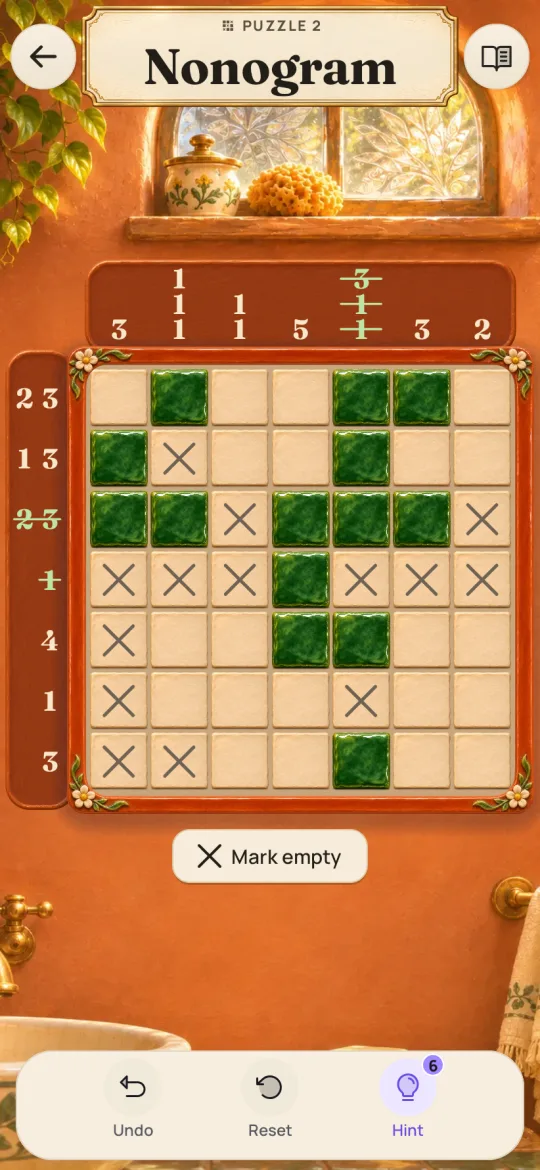
Tap or drag to colour boxes, and tap a coloured box to clear it. Turn on Mark empty to put crosses instead, and tap a cross to clear it.
Each drag is 1 step you can undo. A hint highlights boxes you can be sure of and tells you why. Reset starts the board again.