Calcudoku is also known under the brand name KenKen. Other names are MathDoku and, in Dutch, Rekendoku.
The rules
- Use the numbers from 1 up to the grid size once in every row and every column. That is 1, 2, 3 and 4 on a 4 × 4 grid, and 1 to 6 on a 6 × 6 grid.
- The grid is cut into outlined groups. Each group has a little clue.
- + means the numbers in the group add up to the clue.
- × means the numbers in the group multiply to the clue.
- − means you take the small number from the big one. ÷ means you divide the big number by the small one, with nothing left over.
- Groups with − or ÷ always have just 2 boxes.
- = means the box holds just that number. These groups are a single box.
- A number may repeat in a group if the two boxes are not in the same row or column.
Classic KenKen uses the same rules. Its grids can be as big as 9 × 9. In Quirk the grids go from 3 × 3 to 6 × 6.
A worked example
Here is a small 3 × 3 grid. Each row and column needs 1, 2 and 3. The letters show which boxes belong to the same group.
| Column 1 | Column 2 | Column 3 | |
|---|---|---|---|
| Row 1 | A | B | B |
| Row 2 | A | C | D |
| Row 3 | E | C | D |
The clues are: A is 4+, B is 6×, C is 2−, D is 2÷, and E is 2=.
- Group E is a single box with 2=. So row 3, column 1 is 2.
- Group B is 6× in row 1. With 1, 2 and 3, only 2 × 3 makes 6. So B holds 2 and 3.
- Row 1 still needs a 1. The only box left in row 1 is column 1. So row 1, column 1 is 1.
- Group A is 4+ and already has a 1. It needs 3 more, so row 2, column 1 is 3.
- Group C is 2− in column 2. Only 3 and 1 are 2 apart, so C holds 1 and 3.
- Column 2 still needs a 2. The only box left is row 1. So row 1, column 2 is 2.
- Group B needs 2 and 3. That puts 3 in row 1, column 3.
- Row 2 already has a 3 in column 1. So in group C, row 2 gets the 1 and row 3 gets the 3.
- Row 2 now needs a 2 in column 3. Group D is 2÷, and 2 ÷ 1 is 2. So row 3, column 3 is 1.
- The rows now read 1 2 3, then 3 1 2, then 2 3 1. Every row and column has 1, 2 and 3 once.
Beginner techniques
Start with the single boxes
A group with = is just one box. Its number is given, so write it in first. Then that number cannot go in any other box of its row or column.
Find groups with only one answer
Some clues fit only one pair of numbers. On a 4 × 4 grid, 3+ in 2 boxes must be 1 and 2. 7+ must be 3 and 4, and so must 12×.
Big − clues help too. On a 4 × 4 grid, 3− can only be 4 and 1. On a 6 × 6 grid, 5− can only be 6 and 1.
Look for the last spot in a row or column
Pick a number and check one row. If that number fits only 1 box there, put it in. You can do this before a group is fully solved.
A group can claim numbers in a row
Say a 3+ group sits in row 1. It must use 1 and 2 in that row. So no other box in row 1 can use 1 or 2.
Watch for repeats in bent groups
Take 3 boxes in an L shape with the clue 4+. Three numbers that add to 4 must be 1, 1 and 2. The two 1s cannot share a row or column. So they go in the two ends, and the 2 goes in the corner box.
Common mistakes
- Thinking order matters for − and ÷. It does not. 4 and 1 or 1 and 4 both make 3−.
- Forgetting that a number can repeat in a group. This only works when the boxes share no row or column.
- Reading × as +. On a 4 × 4 grid, 4+ and 4× point to different numbers.
- Filling a group so its sum is right, but a number now repeats in a row.
- Guessing. A wrong guess can stay hidden for a long time. Look for a box with only one choice instead.
Questions
Is Calcudoku the same as KenKen?
Yes, the rules are the same. KenKen is a registered brand name. MathDoku and Rekendoku are other names for the same puzzle.
Do I need to be good at maths?
No. You only add, take away, multiply and divide small numbers. In Quirk the numbers never go above 6.
What sizes are there in Quirk?
Quirk has grids from 3 × 3 up to 6 × 6. Bigger grids do not always mean harder puzzles. The clues decide how tricky it is.
Does every puzzle have one answer?
Yes. Each Calcudoku in Quirk has exactly one correct grid.
Is it good for beginners?
Yes. The easiest puzzles are small 3 × 3 grids with simple clues. Later puzzles are bigger and use all four signs.
What can I do when I am stuck?
Ask for a hint. It shows a group, row or column and explains the next step. You can also undo moves or reset the puzzle.
Related puzzles
Playing it in Quirk
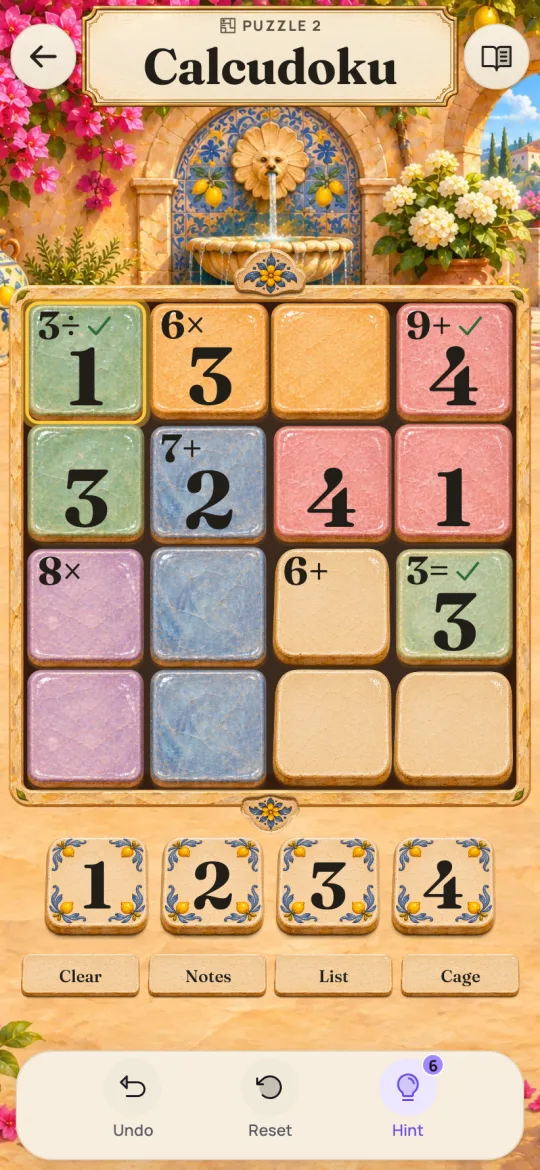
Tap a square, then a number. You then move to the next empty square. Clear empties the square you picked.
Turn on Notes to jot small numbers in a square. Notes are only for you. Cage reads out one group, with its clue and its boxes.