Tapa was made by Serkan Yürekli, a puzzle author from Turkey. Some puzzle books call the black path a wall.
The rules
- In the end, every open box is black or white.
- All black boxes join into 1 path along their sides. The path may branch.
- Use at least 1 black box.
- Never make a black square of 2 by 2 boxes.
- A box with a number always stays white.
- A number tells the sizes of the black groups in the 8 boxes around it, corners too.
- White boxes split black groups. The edge of the board splits them too.
- A box can hold more than 1 number. A 1,3 means a group of 1 and a separate group of 3, never 1 group of 4.
- The numbers in a box can come in any order around it.
- A 0 means all boxes around it are white.
- White boxes do not need to join.
Read the 8 boxes as a ring around the number. The first and last boxes of the ring touch, so a group can wrap around. These are the classic Tapa rules.
A worked example
This board has 3 rows and 3 columns. Three boxes hold a number.
| Column 1 | Column 2 | Column 3 | |
|---|---|---|---|
| Row 1 | 0 | ||
| Row 2 | 2 | 5 | |
| Row 3 |
- Start with the 0 in the top left. Its only open neighbor is row 1, column 2. Make that box white.
- Now look at the 5 in the middle. Three of its 8 neighbors are white: the 0, the 2 and the box you just made white.
- That leaves exactly 5 open boxes: row 1, column 3, then row 2, column 3, then all of row 3.
- These 5 boxes sit one after another in the ring around the 5.
- The 5 needs one group of 5 boxes, so all 5 are black.
- Check the 2 in row 2, column 1. Its black neighbors are row 3, columns 1 and 2. They touch, so they make one group of 2.
- The black path runs down the right side and along the bottom. There is no black 2 by 2 square, so the puzzle is done.
Here is a second board with 3 rows and 3 columns, with 4 numbers.
| Column 1 | Column 2 | Column 3 | |
|---|---|---|---|
| Row 1 | 4 | 2 | |
| Row 2 | |||
| Row 3 | 2 | 4 |
- Look at the 2 in the top right corner. Only 2 open boxes touch it: row 2, columns 2 and 3.
- They sit side by side, and the 2 needs a group of 2. So both are black.
- The 2 in the bottom left works the same way. Its open neighbors are row 2, columns 1 and 2, so both are black.
- Now the 4 in row 1, column 2. Its open neighbors are row 1, column 1 and all 3 boxes of row 2.
- Those 4 boxes sit one after another around the 4. So row 1, column 1 is black too.
- Next, the 4 in row 3, column 2. Its open neighbors are all of row 2, plus row 3, column 3.
- Those 4 boxes also sit one after another, so row 3, column 3 is black as well.
- The black path runs from the top left, along row 2, to the bottom right. There is no black 2 by 2 square.
Beginner techniques
Start with 0 and with the edges
A 0 makes all boxes around it white. A number on the edge or in a corner has fewer boxes around it.
Fewer boxes means fewer ways to fit its groups. Start there.
Keep groups apart
A number like 1,1 or 1,3 needs at least 1 white box between its groups. A box that would join two groups that must stay apart has to be white.
Compare numbers that share boxes
Two numbers close together often look at the same boxes. A shared box must fit both numbers. This can rule out many patterns at once.
No black 2 by 2 squares
If 3 boxes of a 2 by 2 square are black, the fourth box must be white.
Join the black path
All black boxes must join. If only 1 box can link two black parts, make it black.
A box that can never reach the black path must be white.
Common mistakes
- Reading 1,3 as one group of 4.
- Forgetting the corner boxes. The ring has 8 boxes, and the corners count.
- Forgetting that the edge of the board splits groups.
- Making a black 2 by 2 square.
- Leaving 2 black parts that can never join.
- Leaving boxes unmarked. Every open box must be black or white at the end.
Questions
Is Tapa like Minesweeper?
A little. In both, a number looks at the 8 boxes around it. In Tapa, it gives the sizes of the black groups, not just a total.
What does a number like 1,3 mean?
There is a black group of 1 box and a separate group of 3 boxes around it. At least 1 white box keeps them apart.
Do the white boxes have to join?
No. Only the black boxes must join into 1 path. White boxes can be cut off from each other.
Does every puzzle have one solution?
Yes. Quirk checks that each board has exactly 1 answer.
What sizes are there?
Quirk keeps the boards small, up to 8 by 8 boxes. Bigger boards ask you to think more about joining the path.
Is Tapa good for beginners?
It takes a little practice to read the numbers. The first boards are small and have many numbers. A hint tells you which boxes to mark, and why.
Related puzzles
Playing it in Quirk
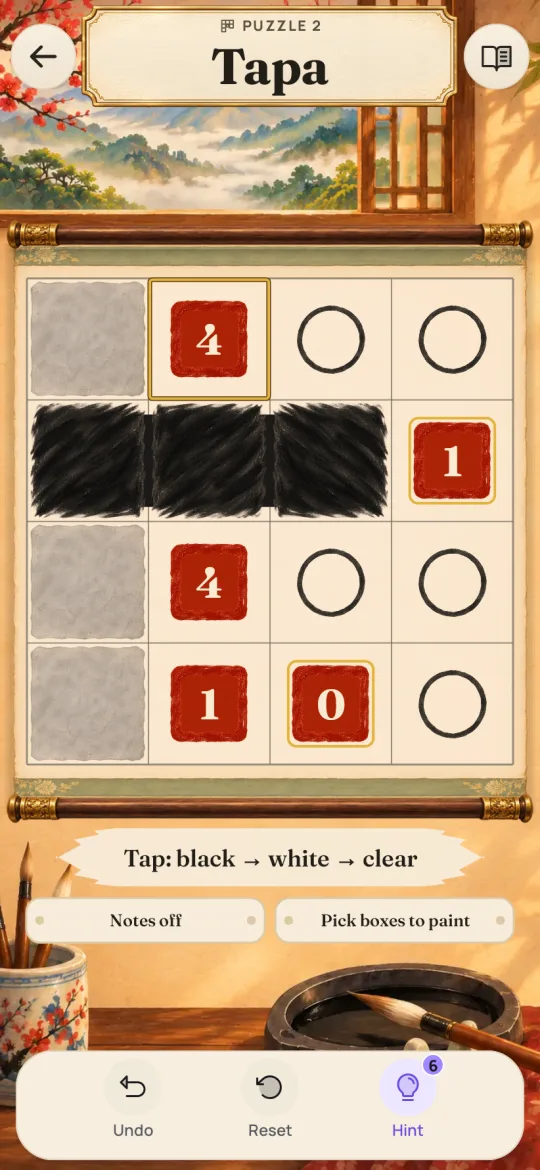
Tap a box to make it black. Tap again for white, and once more to clear it.
Tap a number to see the 8 boxes around it. Quirk can show the patterns that still fit. With notes on, a tap picks a box, and the keys below the board add a note.