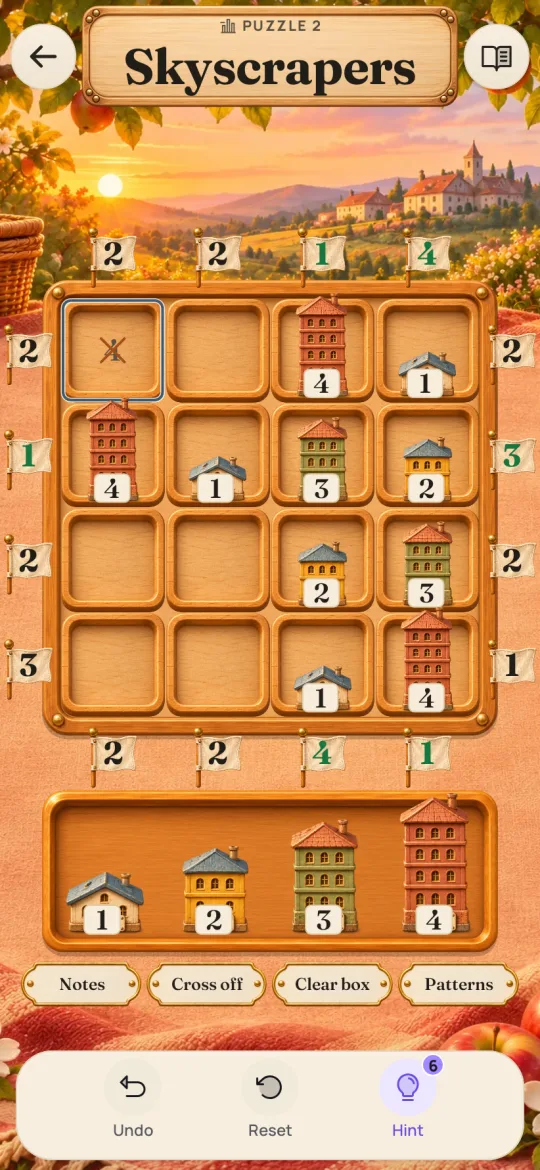
Skyscrapers is also called Towers. Picture each box as a building, seen from the street. Tall buildings hide the shorter ones behind them.
The rules
- Put one building of each height in every row and every column.
- Heights go from 1 to the number of boxes in a row. A 4 by 4 board uses heights 1, 2, 3 and 4.
- The number at the edge tells how many buildings you can see from there.
- A tall building hides every shorter building behind it.
- Left and right clues belong to rows. Top and bottom clues belong to columns.
- A dash means the clue is missing. It never means 0.
- Some boards start with a few heights already in place.
Here is how to count. Take the row 2, 1, 4, 3 and look from the left. You see the 2 and the 4.
The 1 hides behind the 2, and the 3 hides behind the 4. So the left clue for this row is 2.
Quirk uses the classic rules. Boards go from 3 by 3 up to 6 by 6.
A worked example
Here is a small board, 3 boxes wide, with heights 1, 2 and 3. All boxes start empty. These are the clues.
- Left clues, from top to bottom: 3, 2, 1.
- Right clues, from top to bottom: 1, 2, 2.
- Top clues, from left to right: 3, 2, 1.
- Bottom clues, from left to right: 1, 2, 2.
- Row 1 has a left clue of 3. You can only see 3 buildings if they rise in order.
- So row 1 is 1, 2, 3 from the left.
- Row 3 has a left clue of 1. Only the tallest building can stand first, so the first box in row 3 is 3.
- Column 1 now has 1 at the top and 3 at the bottom. The middle box gets 2.
- Row 2 starts with 2, so it needs 1 and 3. Column 3 already has 3 at the top.
- So the last box in row 2 is 1, and the middle box is 3.
- Row 3 starts with 3 and needs 1 and 2. Column 2 already has 2 and 3, so its middle box is 1.
- The last box in row 3 gets 2.
- Check one clue. Row 3 seen from the right reads 2, 1, 3. You see the 2 and the 3, which matches the right clue of 2.
The finished board looks like this.
| Row | Column 1 | Column 2 | Column 3 |
|---|---|---|---|
| 1 | 1 | 2 | 3 |
| 2 | 2 | 3 | 1 |
| 3 | 3 | 1 | 2 |
Beginner techniques
A clue of 1
A clue of 1 sees only the tallest building. So the tallest building stands right next to that edge.
A clue as big as the row
If the clue is as big as the row is long, you see every building. The heights go in order, shortest first.
Tall buildings that block too much
A big clue keeps tall buildings away from its edge. With a clue of 3 on a 4 by 4 board, height 4 cannot be in the first 2 boxes. It would hide too much.
In that same row, height 3 cannot be in the first box either. Only the 4 could show behind it.
Read both ends of a line
Say a row on a 4 by 4 board has 2 on the left and 3 on the right. Only three orders fit: 1 4 3 2, 2 4 3 1 and 3 4 2 1.
All three put height 4 in the second box. So you can place the 4 there, even before you know the rest.
Fill the last gap
Each height goes once in every row and column. When a row or column has one empty box left, the missing height goes there.
Common mistakes
- Counting every building instead of only the ones you can see.
- Reading a clue from the wrong side. A right clue looks from the right edge into the row.
- Treating a dash as 0. It only means there is no clue.
- Thinking a building hides just the one right behind it. It hides every shorter building behind it.
- Using the same height twice in a column while you focus on a row.
Questions
Is Skyscrapers the same as Towers?
Yes. Towers is the name used in Simon Tatham's puzzle collection. The rules are the same.
Does every puzzle have one answer?
Yes. Every Quirk board has exactly one answer. You can reach it by thinking it through, without guessing.
What sizes are there?
Quirk boards go from 3 by 3 up to 6 by 6. On bigger boards, some edge clues can be missing.
What is a pattern in Quirk?
A pattern is a whole row or column written in order, like 1 4 3 2. Quirk can show every pattern that still fits a line. It lists them when 8 or fewer remain, and shows the count when there are more.
Is it good for beginners?
Yes. The first boards are small, and short lessons show each idea. If you get stuck, a hint points to the next step. You can also undo a move or reset the board.
Related puzzles
Playing it in Quirk
Pick a box, then tap a height. Turn on Notes to write small reminders. Use Cross off to mark heights that cannot go in a box. Clear box empties it again.
Open the row and column view to see the patterns that still fit. Pick a pattern to fill its whole row or column in one move. You can undo that move. On a keyboard, arrow keys pick a box and number keys place heights.