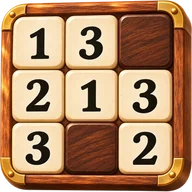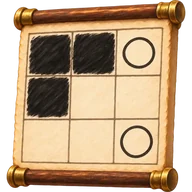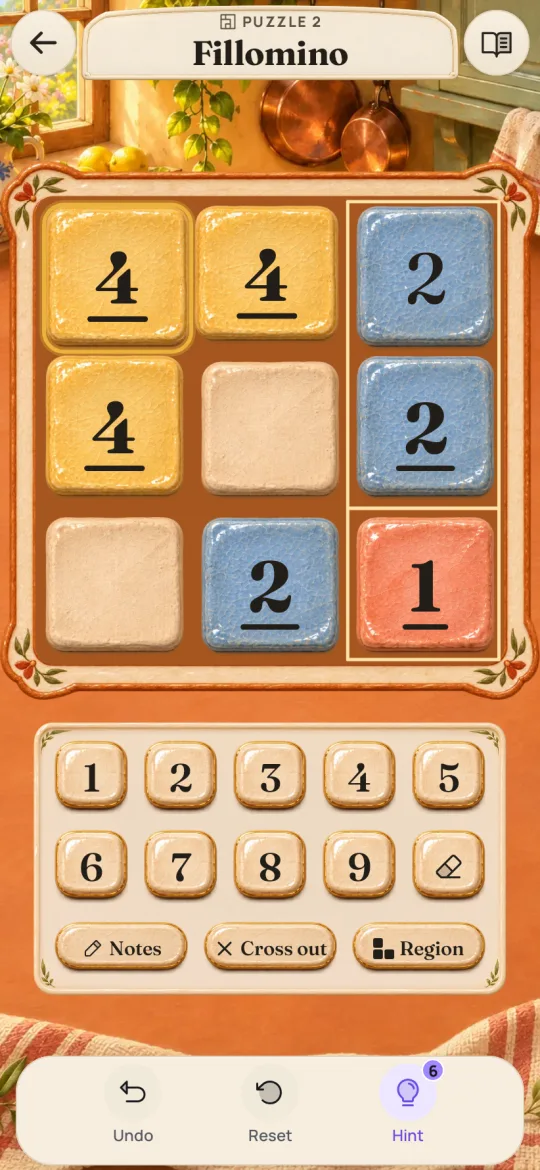
For example, three 3s that touch make a finished group. A 1 always stands alone.
The rules
- Write a number from 1 to 9 in every empty box.
- Boxes touch when they share a side. Touching at a corner does not count.
- Touching boxes with the same number form a group.
- Each group has exactly as many boxes as its number. A group of 3s has 3 boxes.
- Two groups with the same number may not touch side by side. They would join into one group that is too big.
- You cannot change the starting numbers.
- A group may have several starting numbers, or none at all.
In classic Fillomino, numbers can go above 9. Quirk keeps them from 1 to 9, and never above the number of boxes on the board.
A worked example
This board has 3 rows and 3 columns. Only 2 boxes in row 2 are empty.
| Column 1 | Column 2 | Column 3 | |
|---|---|---|---|
| Row 1 | 1 | 4 | 4 |
| Row 2 | 4 | ||
| Row 3 | 3 | 1 | 4 |
- Look at the 4s first. There are four of them, and they are joined along their sides.
- So the group of 4s is full. The empty box in row 2, column 2 cannot be a 4.
- Now look at the 3 in row 3, column 1. It needs 2 more boxes.
- To its right is a starting 1, which cannot change. So the 3 must grow up into row 2, column 1.
- That makes two 3s. The only empty box next to them is row 2, column 2.
- Write a 3 there. Now the group has three 3s and is complete.
- Check the 1s. Each one touches only other numbers, so each is a group of 1. The board is done.
Here is a tiny second board with 2 rows and 2 columns. Only the top left box has a number, a 1.
- The 1 is already a full group.
- The boxes to its right and below it cannot be 1. A 1 there would touch the other 1.
- The 3 empty boxes make an L shape around the bottom right corner.
- Try splitting them into a pair of 2s and 1 single box. Any pair leaves 1 box on its own next to the starting 1.
- A box on its own would have to be a 1, and that is not allowed there.
- So all 3 empty boxes make one group. Write a 3 in each of them.
Beginner techniques
Close off full groups
When a group has all its boxes, it cannot grow. The boxes next to it cannot have that number, so cross it out there.
Grow where there is only 1 way
Sometimes an unfinished group can grow into only 1 empty box. That box gets the same number.
Count every box that would join
Before you write a number, look for groups with that number next to the box. Count their boxes and add 1 for the new box.
If the total is more than the number, it cannot go there.
Check if there is room
A 4 needs 4 boxes. If it can reach only 3 free boxes, a 4 cannot go there.
If a group can reach just enough boxes, all of those boxes belong to it.
Fill empty areas with no number
Some areas between full groups have no starting number. Try the few ways to split them into groups. Keep only what every working way agrees on.
Common mistakes
- Letting two groups with the same number touch side by side. They join into one big group.
- Thinking that corners join boxes. Only shared sides count.
- Counting only the group you are building, and not the group it would join.
- Thinking each group needs a starting number. Some groups have none.
- Forgetting the empty areas. Every box needs a number in the end, even far from the starting numbers.
Questions
Can two groups have the same number?
Yes, as long as they do not touch side by side. Two groups of 2 may touch at a corner.
Does every group need a starting number?
No. A group may have several starting numbers or none. You work out the empty ones from the space that is left.
What numbers are used?
Quirk uses the numbers 1 to 9. On a very small board, numbers never go above the number of boxes.
Does every puzzle have one solution?
Yes. Quirk checks that each board has exactly 1 answer.
How is Fillomino different from Shikaku?
In Shikaku, every area is a rectangle with exactly 1 number. In Fillomino, groups can have any shape, and some have no starting number.
Is Fillomino good for beginners?
Yes. The first boards are tiny, with only a few empty boxes. A hint points to a box and explains why.
Related puzzles
Playing it in Quirk
Pick a box, then pick a number. Notes let you write small reminders. Cross out rules a number out for a box, and Erase clears it.
With Region, you can pick several boxes and fill them in one go. Quirk draws the lines between groups from your numbers, so always count the whole group.