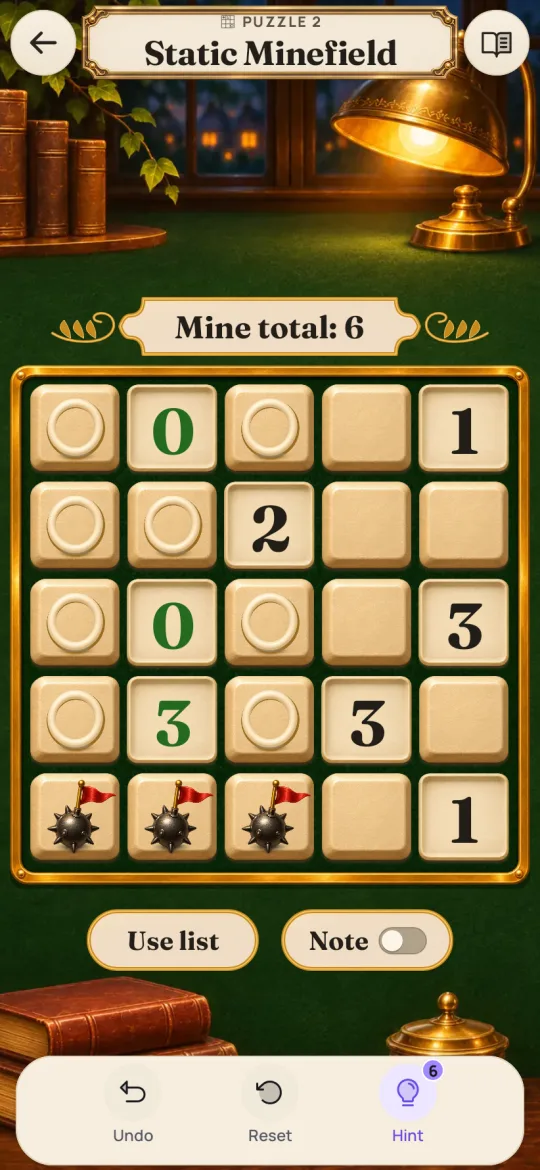
Static Minefield is based on Minesweeper. As a pen-and-paper logic puzzle, it is also called a Minesweeper puzzle or no-guess Minesweeper.
The big difference is that every number is on the board from the start. Nothing opens up while you play, so you solve it by thinking, not by luck.
The rules
- Each number counts the hidden mines touching its tile, also at the corners.
- A number can touch up to 8 tiles: above, below, left, right and the 4 corners.
- Number tiles are never mines. They always stay Safe.
- Mark exactly as many mines as the mine total says, so that every number is right.
- You win when every number and the total are right. Tiles you left unmarked then count as Safe.
In classic Minesweeper, you open tiles one by one and new numbers appear. A wrong tap ends the game, and sometimes you must guess.
In Static Minefield, marking a tile reveals nothing, and you never have to guess.
A worked example
This board has 3 rows of 4 tiles. The mine total is 1. Row 1 holds four numbers, and rows 2 and 3 are blank.
| Column 1 | Column 2 | Column 3 | Column 4 | |
|---|---|---|---|---|
| Row 1 | 1 | 1 | 0 | 0 |
| Row 2 | blank | blank | blank | blank |
| Row 3 | blank | blank | blank | blank |
- Start with the 0 in row 1, column 3. It touches row 2, columns 2, 3 and 4.
- A 0 means no mines touch it. Mark those three tiles Safe.
- Now look at the 1 in row 1, column 1. It touches two blank tiles: row 2, columns 1 and 2.
- Row 2, column 2 is Safe. So the mine must be in row 2, column 1. Mark it Mine.
- Check the 1 in row 1, column 2. It touches row 2, columns 1, 2 and 3. It has exactly one mine, so it is right.
- Row 3 touches no number at all. But the total is 1, and you already found that mine.
- So every tile in row 3 is Safe. The puzzle is solved.
The second board has 3 rows of 3 tiles. The mine total is 2. Row 1 reads 1, 2, 1. Row 3 also reads 1, 2, 1. Row 2 is blank.
| Column 1 | Column 2 | Column 3 | |
|---|---|---|---|
| Row 1 | 1 | 2 | 1 |
| Row 2 | blank | blank | blank |
| Row 3 | 1 | 2 | 1 |
- The 1 in the top-left corner touches two blank tiles: the left and middle tiles of row 2. One of them is a mine.
- The 2 in the middle of row 1 touches all three blank tiles. It needs 2 mines there.
- One mine is already in the left or middle tile. So the second mine must be the right tile. Mark it Mine.
- The 1 in the top-right corner touches the middle and right tiles. Its mine is the right tile, so the middle tile is Safe.
- Go back to the top-left 1. The middle tile is Safe, so the left tile is the mine. Mark it Mine.
- Row 3 works the same way and agrees. You have 2 mines, which matches the total.
Beginner techniques
Start with a 0
A 0 has no mines around it. Every blank tile touching it is Safe.
Count the mines still needed
For each number, count the mines you already marked around it. Then count its blank tiles that are still unmarked.
If no more mines are needed, those tiles are all Safe. If the mines needed equal the unmarked tiles, they are all mines.
Look at the extra tile
Sometimes one number touches all the blank tiles of another number, plus a few extra tiles.
Take away the mines the smaller group needs. What is left tells you how many mines the extra tiles hold. If that is 0, they are Safe.
Use three numbers together
When two numbers are not enough, try a third number that shares the same tiles.
The second example above shows a pattern worth knowing. Each 1 touches two of the three blank tiles, and the 2 touches all three. Then the outer tiles are mines and the middle one is Safe.
Use the mine total
The mine total covers the whole board, even tiles far from any number.
When you have found all the mines, every other tile is Safe. When the mines still needed equal the unmarked tiles, all of them are mines.
Common mistakes
- Forgetting that corner tiles count too.
- Trying to mark a number tile as a mine. Number tiles always stay Safe.
- Ignoring the mine total, which often solves the last part of the board.
- Waiting for tiles to open up, as in classic Minesweeper. Marking a tile shows nothing new.
- Guessing. Every step can be worked out from the numbers and the total.
Questions
Is Static Minefield the same as Minesweeper?
The numbers work the same way. But all numbers are shown from the start, nothing opens up, and there is no timer.
Do I ever have to guess?
No, you never have to guess. The numbers and the mine total always give you enough to go on.
What happens if I mark a mine by mistake?
Nothing goes off. A mark is just your answer, and you can change it. Tap the tile again, or use undo.
Do I have to mark every Safe tile?
No. When every number and the total are right, you win. Tiles left unmarked then count as Safe.
What sizes are there?
Boards in Quirk come in 4 by 4, 5 by 5 and 8 by 8. Bigger boards have more mines.
What can I do when I am stuck?
Ask for a hint. It points to the tiles that matter and explains how to mark them. You can also undo moves or reset the board.
Related puzzles
Playing it in Quirk
Tap a tile without a number to step it through Mine, Safe and empty. Drag across tiles to mark many of them Safe at once.
With Note on, a tap adds a note, which does not change your answer. If you prefer, the list shows the same tiles as the board.