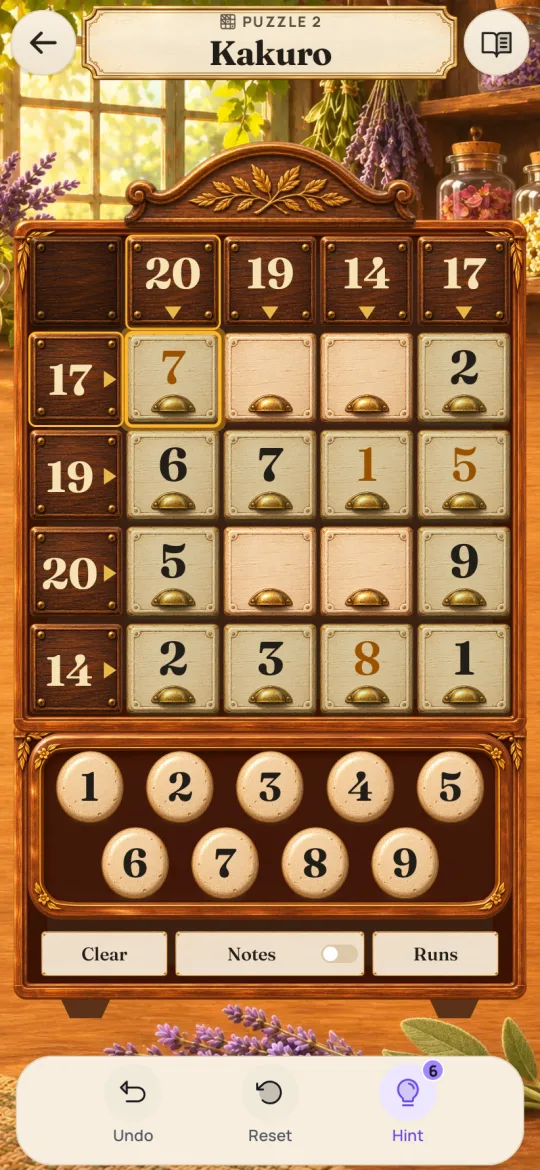
Kakuro is also called Cross Sums. In German it is called Kreuzsummen. It looks like a crossword, but you fill it with numbers instead of letters.
The rules
- Put one number from 1 to 9 in each white box.
- Each line of white boxes adds up to the number at its start. A line is also called a run.
- Inside one run, never use the same number twice.
- A number may come back in another run.
- The little arrow on a dark box shows which way its run goes: right or down.
- A dark box with 2 numbers starts 2 runs. The top-right number goes right, and the bottom-left number goes down.
- Numbers that are already on the board stay.
In books, a dark box is often split by a slanted line. The sum for the run going right sits above the line. The sum for the run going down sits below it. Quirk adds a little arrow, so you see the direction at once.
A worked example
Example 1: a small square
Here is a small square of 4 white boxes, in 2 rows and 2 columns. These are its sums.
| Run | Boxes | Sum |
|---|---|---|
| Top row | 2 | 3 |
| Bottom row | 2 | 7 |
| Left column | 2 | 4 |
| Right column | 2 | 6 |
- The top row makes 3 with 2 boxes. The only way is 1 and 2.
- The left column makes 4 with 2 boxes. 2 and 2 would repeat a number, so it must be 1 and 3.
- The top-left box is in both runs. The only number in both pairs is 1, so it takes 1.
- The top row needs 3, so the top-right box is 3 minus 1, which is 2.
- The left column needs 4, so the bottom-left box is 4 minus 1, which is 3.
- The bottom row needs 7 and already has 3. So the bottom-right box is 4.
- Check the right column: 2 plus 4 is 6. Every run adds up, and no run repeats a number.
The top row reads 1, 2 and the bottom row reads 3, 4.
Example 2: a pair that matters
A run of 3 boxes goes right with the sum 6. Call its boxes A, B and C, from left to right.
- 6 in 3 boxes can only be 1, 2 and 3.
- Box A also sits in a down run of 2 boxes with the sum 3. So A can only be 1 or 2.
- Box B also sits in a down run of 2 boxes with the sum 3. So B can only be 1 or 2 as well.
- A and B use up 1 and 2 between them. So neither number can go in box C.
- Box C takes 3. Other runs will tell you which of A and B gets the 1.
Beginner techniques
Learn the sums with only one answer
Some sums can only be made one way. 3 in 2 boxes is always 1 and 2. 24 in 3 boxes is always 7, 8 and 9. This table shows the most useful ones.
| Boxes | Sum | Numbers |
|---|---|---|
| 2 | 3 | 1 and 2 |
| 2 | 4 | 1 and 3 |
| 2 | 16 | 7 and 9 |
| 2 | 17 | 8 and 9 |
| 3 | 6 | 1, 2 and 3 |
| 3 | 7 | 1, 2 and 4 |
| 3 | 23 | 6, 8 and 9 |
| 3 | 24 | 7, 8 and 9 |
| 4 | 10 | 1, 2, 3 and 4 |
| 4 | 11 | 1, 2, 3 and 5 |
| 4 | 29 | 5, 7, 8 and 9 |
| 4 | 30 | 6, 7, 8 and 9 |
| 5 | 15 | 1, 2, 3, 4 and 5 |
| 5 | 35 | 5, 6, 7, 8 and 9 |
The table tells you which numbers to use, not their order. The runs that cross decide where each number goes.
Check where two runs cross
Every white box sits in one run going right and one run going down. Its number must fit both. Think of the numbers each run can use, and keep only the ones they share.
Fill the last box
Subtract the numbers already placed from the sum of the run. The last empty box needs the number that is left.
Say a run of 3 boxes adds up to 20 and already holds 9 and 4. Those make 13, so the last box is 20 minus 13, which is 7.
Rule out numbers that are too big or too small
Take 2 boxes that add up to 14. No box can hold 1 to 4, because the other box would need more than 9. It cannot hold 7 either, because 7 and 7 repeat. So each box holds 5, 6, 8 or 9.
Spot a pair
Sometimes 2 boxes in one run can only hold the same 2 numbers. Those 2 numbers then belong to that pair. Remove them from the other boxes in the run.
Common mistakes
- Using the same number twice in one run.
- Playing it like Sudoku. A number may come back in another run, even in the same row.
- Mixing up the two sums on a dark box. The top-right sum goes right, and the bottom-left sum goes down.
- Taking the order from the table. 3 in 2 boxes is 1 and 2, but either one can come first.
- Using 0. Only the numbers 1 to 9 are allowed.
Questions
Is Kakuro the same as Cross Sums?
Yes. Cross Sums is a name used in many English puzzle magazines. Kreuzsummen is the German name. The rules are the same.
Is Kakuro like Sudoku?
Both use the numbers 1 to 9. Kakuro has no 3 by 3 blocks and no rule for whole rows or columns. A number must only be different inside its own run, and each run must reach its sum.
Do I need to be good at maths?
No. You only add and subtract small numbers. Knowing a few sums with one answer helps more than adding fast.
Does every puzzle have one solution?
Yes. Each Quirk Kakuro has exactly one answer, and you can reach it without guessing.
How big are Quirk's boards?
Quirk's Kakuro boards are small. They are at most 8 boxes wide and 8 boxes high. Each run has 2 to 6 white boxes.
What does the Sums button do?
It helps on harder boards. Pick a box, then pick runs going right and runs going down. They must cover the same boxes, with your box as the only extra one on the right side. The right total minus the down total gives the number for your box.
Say two runs going right add up to 16 together. Two runs going down add up to 10 and cover the same boxes, except your box. Your box then holds 16 minus 10, which is 6.
Related puzzles
Playing it in Quirk
Numbers that are already there stay. Tap an empty box, then a number. Turn on Notes to write small reminders in a box, then place numbers to finish the board.
Open the Run list and tap a sum to outline its run. Zoom shows part of the board larger. A hint explains the next step, and you can undo or reset at any time.