Spiral Galaxies is also called Tentai Show, its Japanese name. Some puzzle collections call it Galaxies.
The rules
- The board is made of small squares called cells. Every cell belongs to exactly 1 galaxy.
- Each galaxy has exactly 1 dot.
- Each galaxy is one piece. Its cells join side by side.
- Turn a galaxy halfway round its dot, like turning a picture upside down. It must look exactly the same.
- A dot sits in the middle of a cell, on a line between 2 cells, or where 4 cells meet.
- A dot on a line owns both cells it touches. A dot where 4 cells meet owns all 4.
Every cell has a mirror, equally far across its dot. Say a cell is 1 step left and 2 steps up from the dot. Its mirror is then 1 step right and 2 steps down. A cell and its mirror always belong to the same galaxy.
These are the classic rules. Quirk does not change them.
A worked example
The first board has 3 rows and 3 columns. Dot A sits in the middle of row 1, column 2. Dot B sits on the line between row 2, column 2 and row 3, column 2.
- Row 1, column 2 holds dot A, so that cell belongs to A.
- Dot B touches row 2, column 2 and row 3, column 2. Both belong to B.
- Look at row 1, column 1. Its mirror across B would be below row 3, off the board. So it cannot join B.
- Its mirror across A is row 1, column 3. Both cells join A. Galaxy A is now the whole top row.
- Look at row 2, column 1. Its mirror across A would be above row 1, off the board. Its mirror across B is row 3, column 3. Both join B.
- In the same way, row 2, column 3 and row 3, column 1 join B. Galaxy B is now rows 2 and 3, and every cell is used.
The second board has 4 rows and 4 columns. Each corner cell has a dot in its middle. Dot E sits where rows 2 and 3 meet columns 2 and 3.
- Dot E touches 4 cells: rows 2 and 3, columns 2 and 3. All 4 belong to E.
- Now try to give a corner dot another cell. Its mirror would always land off the board. So each corner galaxy is just its own cell.
- The 8 cells left along the edges cannot join a corner galaxy. They all join E.
- Check: galaxy E has 12 cells and looks like a square with its corners cut off. A half turn lands it on itself, and it is one piece.
Beginner techniques
Cells that touch a dot
Start here. A dot inside a cell owns that cell. A dot on a line owns the 2 cells it touches. A dot where 4 cells meet owns all 4.
Mirror off the board
Check a cell's mirror across each dot. If the mirror is off the board or in another galaxy, that dot cannot own the cell.
Always work in pairs
When a cell joins a galaxy, its mirror joins too. Thinking in pairs halves the work and stops lopsided galaxies.
Stay in one piece
A galaxy cannot take a cell it has no path to. If only 1 galaxy can reach a cell through cells it could own, the cell belongs to that galaxy.
The only way through
Sometimes a loose part of a galaxy needs one cell to reach its dot. Add that cell, and its mirror too.
Common mistakes
- Adding a cell but not its mirror.
- Making a galaxy that matches itself left to right but not after a half turn. Only the half turn counts.
- Making a galaxy in 2 pieces. Both halves can look right and still break the rule.
- Forgetting that a dot on a line or at a meeting point owns the cells around it.
- Leaving a cell with no galaxy at all.
Questions
Is Spiral Galaxies the same as Tentai Show?
Yes. Tentai Show is the Japanese name for the same puzzle, with the same rules.
Do galaxies have to look like spirals?
No. A galaxy can be any shape, as long as it is one piece and passes the half turn test.
Can a galaxy be just 1 cell?
Yes. A dot can sit in the middle of a cell. If no other cell fits, that cell is a whole galaxy.
What sizes are there?
Boards go from 4 by 4 up to 8 by 8. Bigger boards have more dots and longer paths to check.
Does every puzzle have one answer?
Yes. Each board in Quirk has exactly one answer, and you can find it without guessing.
Is it good for beginners?
Yes. The first lessons show how a cell and its mirror join a galaxy. Later lessons add one idea at a time.
Related puzzles
Playing it in Quirk
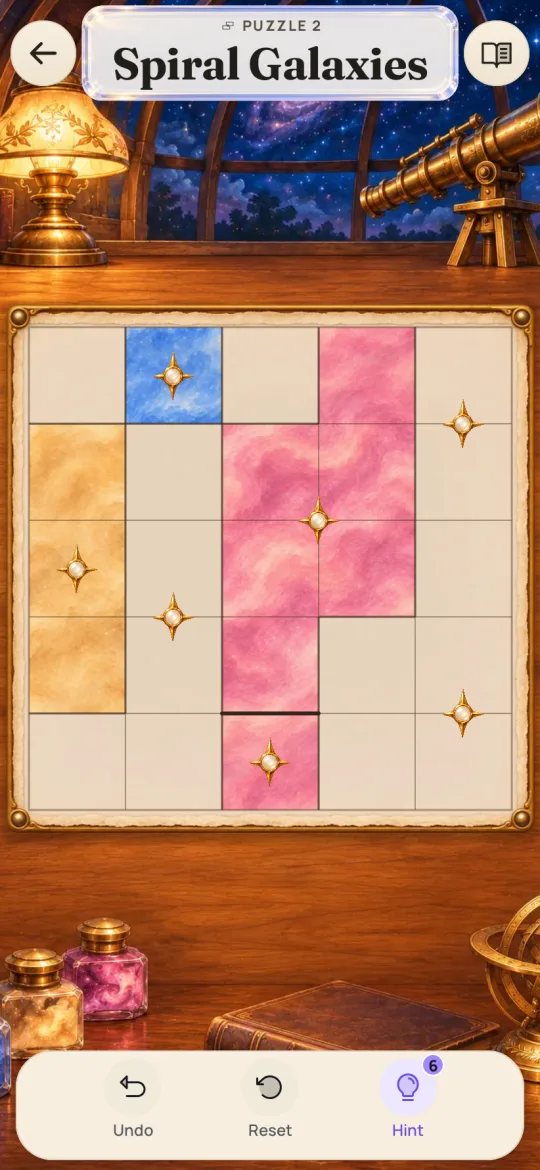
Tap a dot to choose its galaxy. Then tap or drag over cells to add them, and their mirrors across the dot join too. Tap a cell in the chosen galaxy to take it and its mirror out again.
With no dot chosen, tap a galaxy to choose it. If you get stuck, a hint shows the next step and why. You can undo a move or start again.