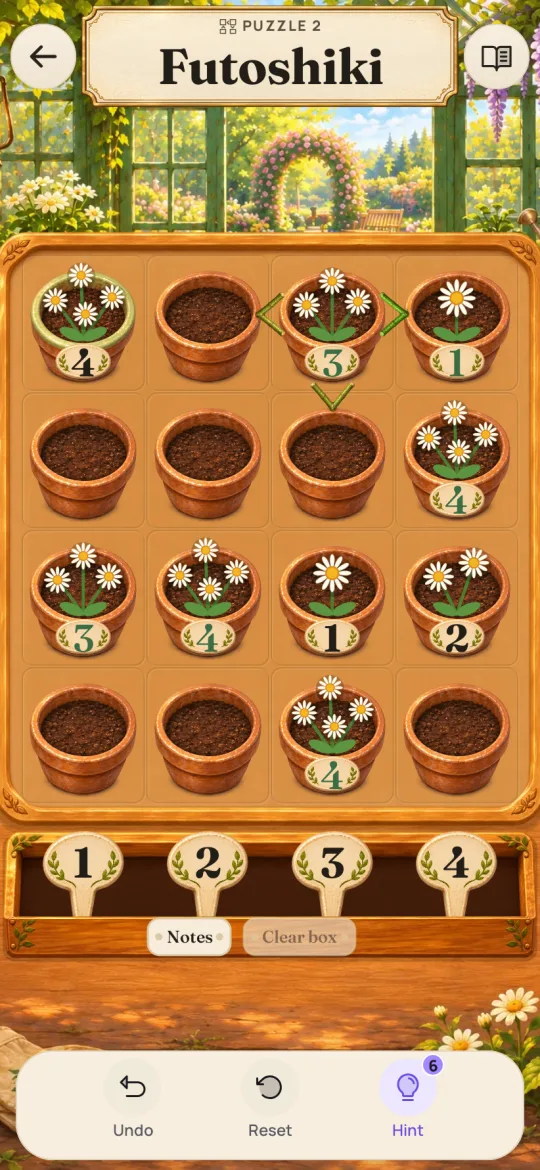
Futoshiki comes from Japan, and its name means inequality. You may also know it as Unequal or More or Less.
The rules
- Put each number once in every row and every column.
- A board 4 boxes wide uses 1, 2, 3 and 4. A board 5 boxes wide uses 1 to 5.
- The pointy end of each sign points to the smaller number.
- So in 2 < 3, the 2 is smaller. In 4 > 1, the 1 is smaller.
- Signs can sit between 2 boxes in a row, or between 2 boxes in a column.
- Where there is no sign, there is no rule. Those 2 numbers can be in either order.
- Some boards start with a few numbers. Starting numbers stay fixed.
Quirk uses the classic rules. Many printed puzzles are 5 by 5. In Quirk, boards go from 3 by 3 up to 6 by 6.
A worked example
Here is a small board, 3 boxes wide. It uses the numbers 1, 2 and 3. All boxes start empty, and there are 4 signs.
- Row 1 has 2 signs: box 1 < box 2 < box 3.
- Row 2 has 1 sign, between box 2 and box 3. It points to box 3, so box 3 is smaller.
- Column 1 has 1 sign, between row 2 and row 3. It points up to row 2, so row 2 is smaller.
- Look at row 1. Each box must be bigger than the one before it.
- With only 1, 2 and 3, row 1 must be 1, 2, 3 from left to right.
- Now look at column 1. It has 1 at the top, so rows 2 and 3 need 2 and 3.
- The sign in column 1 says row 2 is smaller. Put 2 in row 2 and 3 in row 3.
- Row 2 starts with 2. Its other 2 boxes need 1 and 3.
- The sign in row 2 says box 3 is smaller. So box 2 gets 3, and box 3 gets 1.
- Row 3 starts with 3 and needs 1 and 2. Column 2 already has 2 and 3, so box 2 gets 1.
- The last box in row 3 gets 2. Column 3 now has 3, 1 and 2, so each number shows once.
The finished board looks like this.
| Row | Column 1 | Column 2 | Column 3 |
|---|---|---|---|
| 1 | 1 | 2 | 3 |
| 2 | 2 | 3 | 1 |
| 3 | 3 | 1 | 2 |
Beginner techniques
Follow a chain of signs
Signs often form a chain, like box A < box B < box C. Each step up adds at least 1.
On a 4 by 4 board, the first box in that chain can only be 1 or 2. The last box can only be 3 or 4.
The smallest and the biggest
The box at the pointy end of a sign is smaller than its neighbour. So it can never hold the biggest number. The box at the open end can never hold 1.
Bigger than both neighbours
Sometimes a box is bigger than the box on its left and the box on its right. Those 2 neighbours share a row, so they need different numbers. That means the middle box needs at least 3.
The same works in a column, and the other way round. On a 4 by 4 board, a box smaller than both its row neighbours can only be 1 or 2.
Check both sides of a sign
Say the left box can hold 1 or 3, and the right box can hold 1 or 2. The sign says the left box is bigger.
A 1 on the left would need something smaller on the right, and nothing fits. So the left box is 3.
Look at the row and column together
Before you place a number, check its row, its column and every sign that touches the box. Often only 1 number is left. Notes help you keep track.
Common mistakes
- Reading a sign the wrong way round. The pointy end always faces the smaller number.
- Thinking a missing sign tells you something. No sign means no rule.
- Thinking a sign means the numbers differ by 1. The pair 1 < 4 is fine too.
- Checking the row but forgetting the column. A number can repeat there without you noticing.
- Guessing when you are stuck. Look for a chain of signs, or ask for a hint.
Questions
Is Futoshiki the same as Unequal?
Yes. Unequal is the name used in Simon Tatham's puzzle collection. Some books call it More or Less. The rules are the same.
Is Futoshiki like Sudoku?
A little. Each number goes once in every row and column, just like Sudoku. But there are no smaller areas to fill, and the signs give most of the clues.
Does every puzzle have one answer?
Yes. Every Quirk board has exactly one answer. You can reach it by thinking it through, without guessing.
What sizes are there?
Quirk boards go from 3 by 3 up to 6 by 6. Small boards teach the signs. Bigger boards ask you to combine rows, columns and signs.
Is it good for beginners?
Yes. The first boards are small, and short lessons show each idea. If you get stuck, a hint points to the next step. You can also undo a move or reset the board.
Related puzzles
Playing it in Quirk
Tap a box, then tap a number. Turn on Notes to write small reminders in a box. Clear box takes out a number. Tap it again to take out the notes too.
Starting numbers stay fixed. Tap a sign to read what it says. If a number repeats or breaks a sign, Quirk shows you where.