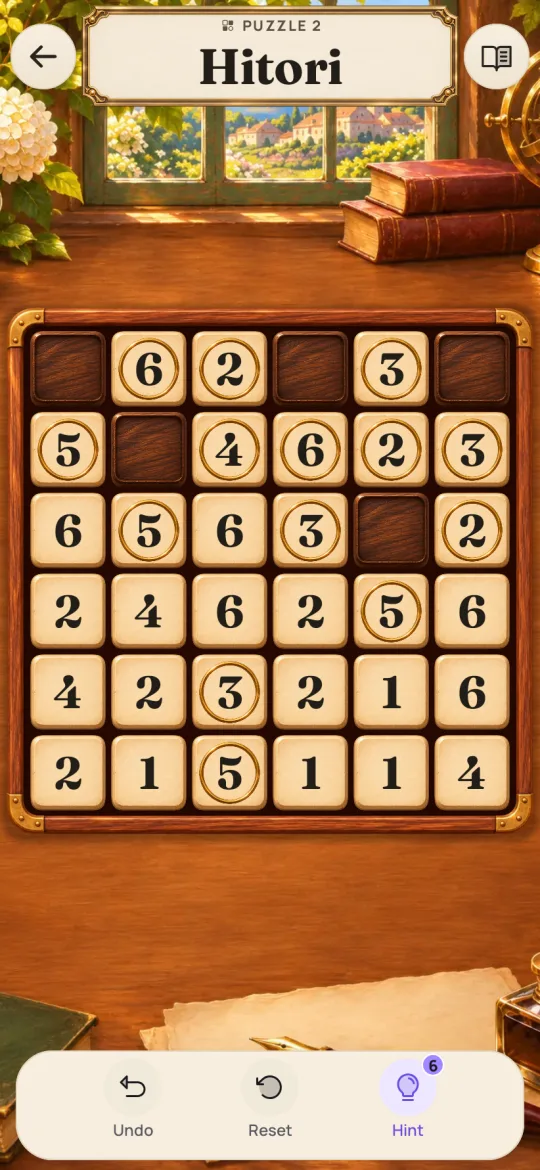
Hitori comes from Japan. The name means alone: in the end, every number stands alone in its row and column.
The rules
- Shade numbers so no number shows twice in any row or column.
- Shaded boxes may touch at corners, but never sit side by side.
- All the other boxes must stay joined along their sides.
- There is no fixed number of boxes to shade.
- Only unshaded numbers count. A shaded number no longer counts as a repeat.
Quirk uses the classic rules. Boards start small and go up to 8 by 8.
A worked example
Here is a small board, 3 boxes wide.
| Row | Column 1 | Column 2 | Column 3 |
|---|---|---|---|
| 1 | 1 | 2 | 2 |
| 2 | 3 | 1 | 3 |
| 3 | 2 | 3 | 3 |
- Row 2 reads 3 1 3. If you shaded the 1, neither 3 could be shaded, because both touch the 1.
- Then both 3s would stay, and that is a repeat. So the 1 in the middle stays unshaded.
- Now look at the 3 in the bottom right corner. Suppose it stays unshaded.
- Then the 3 on its left must be shaded, and so must the 3 above it.
- That would close off the corner box, which breaks the joining rule. So shade the bottom right 3.
- The boxes next to a shaded box stay unshaded. So the 3 in row 3, column 2 stays, and the 3 in row 2, column 3 stays.
- The 3 at the end of row 2 stays, so the other 3 in row 2 must be shaded. Shade row 2, column 1.
- Its neighbours stay unshaded: the 1 at the top left and the 2 at the bottom left.
- Row 1 still has two 2s. Shading the middle one would close off the 1 at the top left.
- So the middle 2 stays, and you shade the 2 in row 1, column 3.
The shaded boxes are row 1 column 3, row 2 column 1 and row 3 column 3. No 2 of them share a side. The 6 unshaded boxes join up, and no number repeats.
Beginner techniques
The middle stays
Look for a pattern like 4 2 4 in a row or column. Shading the 2 would leave both 4s unshaded, so the 2 stays.
Matching numbers side by side
When 2 matching numbers share a side, exactly 1 of them stays unshaded. Any other copy of that number in the same row or column must be shaded.
Next to a shaded box
Every box that shares a side with a shaded box stays unshaded. Mark these right away, and new clues often appear.
A kept number shades its copies
Once you know a number stays, look along its row and its column. Shade every other copy of that number.
Keep everything joined
Keep the unshaded boxes joined. If shading a box would split them apart, keep it. Corners and edges are the first places to check.
Common mistakes
- Shading 2 boxes that share a side.
- Closing off a box. A box that only touches the rest at a corner is cut off.
- Shading a number that has no copy in its row or column. It never needs shading.
- Checking the rows and forgetting the columns.
- Thinking shaded boxes may not touch at all. Touching at a corner is fine.
Questions
Can shaded boxes touch?
Only at their corners. Two shaded boxes may never share a side.
Do I have to mark the boxes I keep?
No. Unmarked boxes count as unshaded. Keep marks are only reminders, so you can skip them.
Does every puzzle have one answer?
Yes. Every Quirk board has exactly one answer. You can reach it by thinking it through, without guessing.
What sizes are there?
Quirk starts with small boards. The biggest boards are 8 by 8.
Is it good for beginners?
Yes. There are only three rules, and short lessons show each idea. If you get stuck, a hint points to the next step. You can also undo a move or reset the board.
Related puzzles
Playing it in Quirk
Tap a box to shade it. Tap again to keep it, and once more to clear it.
Drag across boxes to give them all the mark the first box gets. If a number still repeats, or the unshaded boxes split apart, Quirk shows you where.